
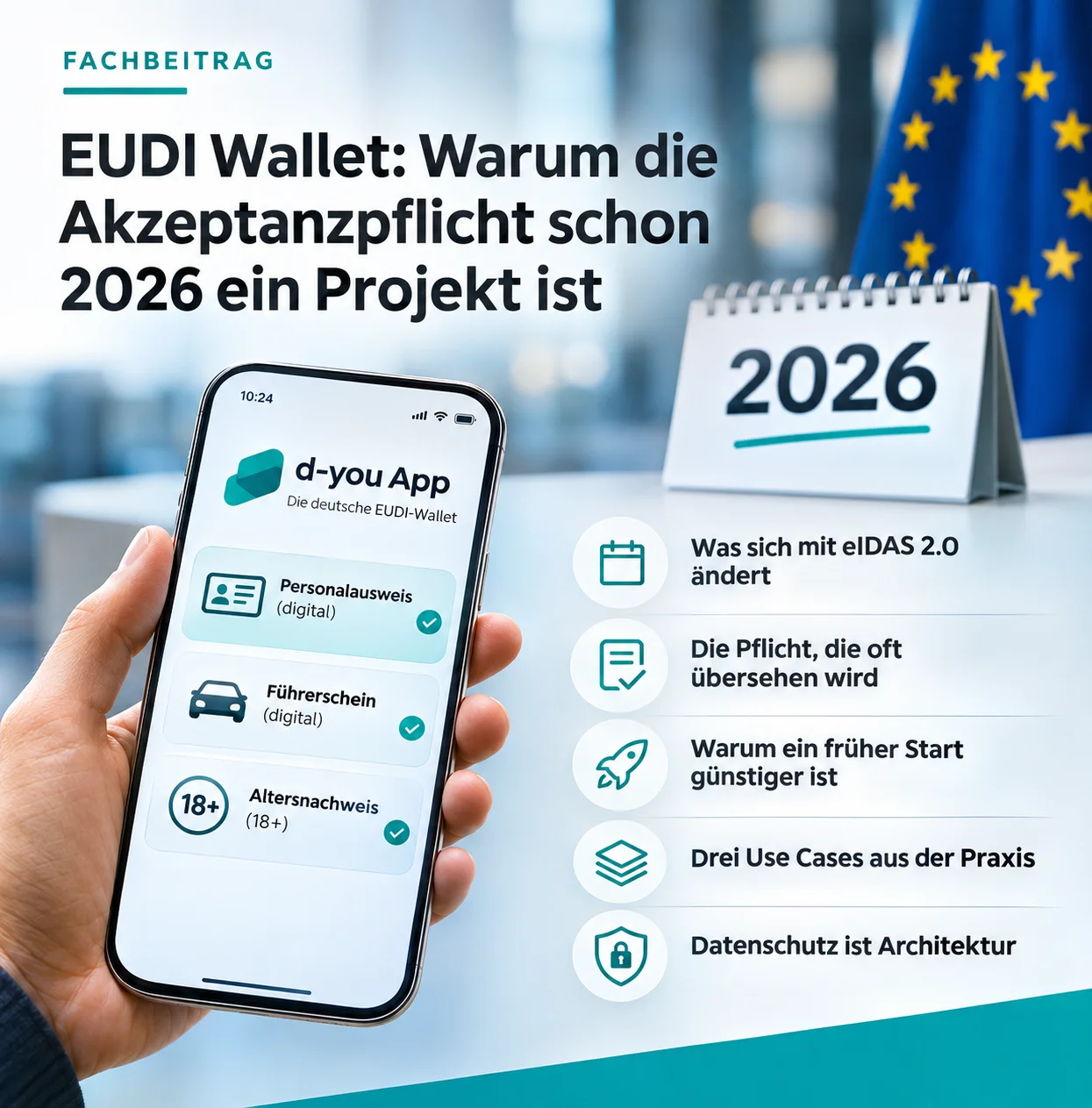
What changes with eIDAS 2.0
Regulation (EU) 2024/1183 obliges every member state to offer at least one EUDI Wallet by the end of 2026. The obligations apply in stages:
- 31 December 2026: every member state provides at least one wallet
- From 2027: public bodies must accept the wallet as proof
- By the end of 2027: the acceptance obligation also applies to defined private providers, e.g. banks, telecommunications, energy, transport, health and social insurance
Micro and small enterprises as defined in EU Recommendation 2003/361/EC are exempt.
The obligation that is often overlooked
The focus is usually on the acceptance obligation under Art. 5f. Less well known is Art. 5b: anyone who requests data from the wallet must register as a relying party in the member state where they are established and state which data they request and for what purpose.
Why an early start costs less
In 2027, user numbers will still be manageable. That is the right moment to gain experience. A working integration is a differentiator in 2027 and a basic requirement two years later.
Three use cases from practice
In the official EUDI Wallet sandbox, mobivention has implemented three scenarios:
- Age verification 18+ without an ID copy: only “over 18” is confirmed
- Verified onboarding without media breaks: the wallet supplies verified data, users confirm in one step
- Pre-filled application forms: with data from the wallet, if the user wishes
Suitable for e-commerce, financial services, public administration and regulated markets such as gaming, among others.
Data protection is architecture
The verification layer only passes on the result and status. The application learns, for example, “18+ = yes”, but never the date of birth.
mobivention EUDI Solutions timeline
- Q3 2026: verification completed
- From Q4 2026: pilot places
- 2 January 2027: go-live alongside the wallet launch
The three scenarios were shown live at EUDI ON 2026.